
In the early stages of your startup, writing a financial forecast is arguably one of the least fun activities, but it’s necessary because if you want to raise money, you’ll need a strong business plan with a set of credible estimates that you can stand up and present to investors.
Unfortunately, a lot of individuals have difficulty understanding this and make serious mistakes. I’ve seen countless pitches with absolutely irrational financial predictions. I’ve even personally delivered a handful of them:
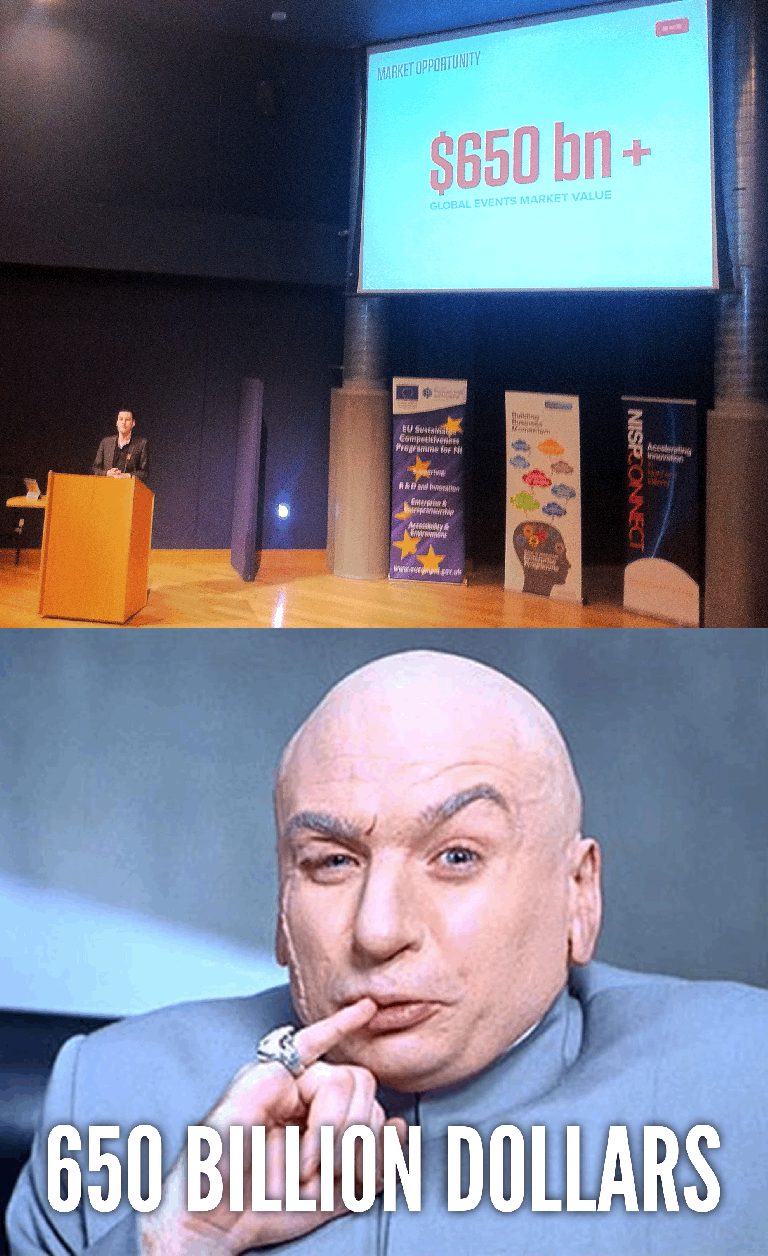
Many predictions are created by pulling a revenue number for the first year out of thin air, multiplying it by three, and then creating a plausible narrative about what would fuel this rise.
Year 1 Year 2 Year 3
Revenue £100k £300k £1m
While producing an accurate set of figures can seem like a black art, fortunately there is a relatively easy formula you can apply to produce a realistic set of projections for your business.
THE MAGIC FORMULA
At the very heart of your financial forecast are two key metrics and the following formula:
marketing spend / customer acquisition cost * customer lifetime value
Your yearly income predictions will be driven by this, and it will also help you figure out how much money you need to raise in order to devote the right marketing budget to meet your goals.
Let’s break this down and explain each part of the formula.
BERAPAKAH CUSTOMER ACQUISITION COST (CAC) SAYA?
This is the amount of cash you need to spend to acquire a new customer, calculated using:
marketing spend / number of signups
For example:
You start an Adwords campaign to advertise your company on the Google search results page, and each time someone hits your ad, you are charged a tiny fee.
The conversion rate—the number of clicks required before someone joins up—must then be calculated, and the cost associated with each new signup must be determined.
So –
- You spend £200 on an Adwords campaign that costs £1 per click
- This generates 200 clickthroughs to your homepage
- 6 people sign up and start paying for your service
- From this simple experiment, you now know that:
- You have a 3% conversion rate (6 signups / 200 clicks)
- Your customer acquisition cost is £33.3 (£200 / 6 signups)
You’ll probably get clients through a variety of marketing channels, so you must independently determine the cost of customer acquisition for each of these channels using the same technique.
Why? The CAC for Adwords is probably higher than for Twitter because the cost to acquire a consumer varies depending on the channel.
You now have the first significant metric; all that is left to do is calculate another.
WHAT IS MY CUSTOMER LIFETIME VALUE (CLV)?
Over the course of their use of your product or service, the average customer will create this amount of income.
This is rather simple to compute for a typical SaaS company.
If a consumer uses your service for an average of two years and you charge a membership fee of £10 a month:
£10 x 24 months = £240 CLV
BUILDING THE PROJECTIONS
Now that we have the two criteria needed to produce your financial forecasts (revenue projections), let’s move on. The input values (marketing budget) for each year of your estimates are now all that are required.
Consider that out of your £300k initial investment, £150k will be spent on marketing in the first year.
Since our CLV spans two years, we can apply our method to determine the revenue for the first two years based on our first yearly marketing budget.
marketing spend / customer acquisition cost * customer lifetime value
£150k / £33,3 * £240 = £1.081.200 (pendapatan dalam dua tahun)
So –
At £33.3 to acquire each new customer, your £150,000 marketing budget will buy you 4,505 customers who will each generate £240 of revenue over two years, totaling just over £1m.
Next, we need to apply the same formula for Year 2 and add the result to the £540k (£1m / 2 years) to produce the second year projections.
Remember – our average customer lifetime is 24 months so the customers aquired in year 1 will still generate revenue in year 2 as well as the revenue generated by new customers.
Year 1 Year 2 Year 3
Marketing Budget £150k £500k £1m
Revenue £540k £2.3m £5.9m
You can then replicate this across Years 3, 4 and 5.
This is a fairly straightforward illustration, yet your company is certainly more intricate than this. If you have different pricing tiers, for instance, you may either compute the general average or divide the estimates into different categories for greater accuracy.
Of all, no one can foretell the future, so it’s possible that your projections won’t come true (though we hope they do!). But using this method, you have a much more relevant and realistic collection of data that are simple to understand.
BUT I’M A STARTUP AND I DON’T HAVE ANY PAYING CUSTOMERS YET?
I get what you’re thinking: how can this be applied to a startup in its early stages when you don’t yet have a marketing budget or paying customers?
Although it will be challenging to establish a precise CAC and CLV in the early phases of your organisation, you can aid with this by doing modest tests.
I really believe that you should test your idea by launching a simple marketing campaign before you even start developing a product.
With a simple, one-page website that describes your product and has a form to gather email addresses, you can accomplish this rather easily.
Then, based on how many people register their interest, you may launch a tiny £500 marketing campaign, test out various channels to generate visitors to the website, and determine your conversion rate and CAC.
You can make an assumption about this, but don’t be overly hopeful. Calculating the CLV won’t be achievable until you have several customers using your product and can estimate the typical amount of time they remain involved.
YOU’RE NO MYSTIC MEG
Having a set of forecasts that you have validated and qualified through this process is a lot better strategy than relying on guessing, even though these numbers will undoubtedly alter as your firm grows.
You should complete this task as soon as you can to adequately validate your business model. In the preceding illustration, we estimated that the typical client would generate £240 over the course of two years while using your product. It is a sign that your company model is flawed if it costs you £300 to attract this consumer.
ALWAYS SEEK PROFESSIONAL ADVICE
If you’re raising investment, it’s always a good idea to get some secondary professional counsel if finance isn’t your strong suit (it’s certainly not mine). You’ll want to ensure that your predictions line up correctly and there’s no room for anyone to find flaws in them.
One of the aspects of your business that you can’t afford to get wrong is your predictions, so hiring a knowledgeable financial consultant to assist you is a wise investment.
I strongly suggest reaching out to the startup finance experts at Nuvem 9 or your accountant, who should be able to assist you.

 Chityphong Alain Banchong - The Pursuit of Greatness